Wrightia arborea (Dennst.) Mabb.
Summary
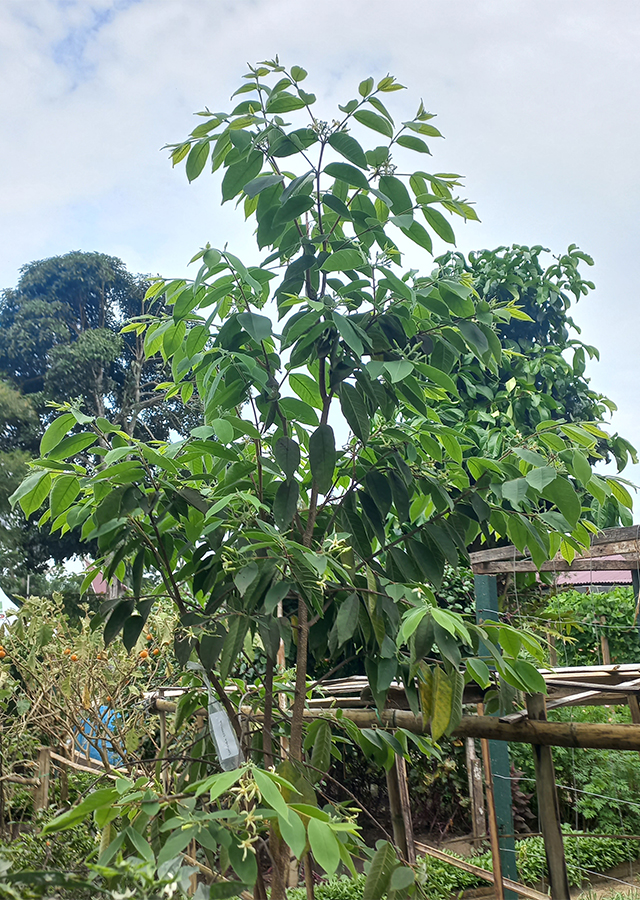
Mentaos (Wrightia arborea) is a tree up to 20 meters tall from the Apocynaceae family distributed from India to Thailand. The Muna tribe of Sulawesi has used mentaos for generations to treat cataracts and as a postpartum care remedy. Its wood is also economically valuable for construction, pencils, and carving.
Agroecology
Mentaos is generally found growing in deciduous forest, shrublands, often along rivers, on sandy or rocky soil, up to elevations of 1,650 m asl. Prefers moist, well-drained soil, with a soil pH degree in the range of 5.5-7, and tolerating a pH of 5-7.5. Grows well in a position in full sun as well as in partial shade. Its growth is also suited to areas where the mean annual daytime temperature is in the range of 22-32°C, but can tolerate 5-45°C, and mean annual rainfall in the range of 1,200-2,400 mm, but tolerates 900-3,800 mm. In general, mentaos can tolerate drought conditions fairly well.
Morphology
- Roots a branching taproot, elongated and cylindrical, whitish brown, the root's terminal section bearing thin true rootlets.
- Stem cylindrical, straight, sometimes bent, without buttress roots but often fluted at the base; bark surface longitudinally cracked, bark surface grayish to yellowish brown, inner bark grainy or fibrous, yellow, exuding milky sap. Hairless or puberulous, with elliptic lenticels, white or grayish.
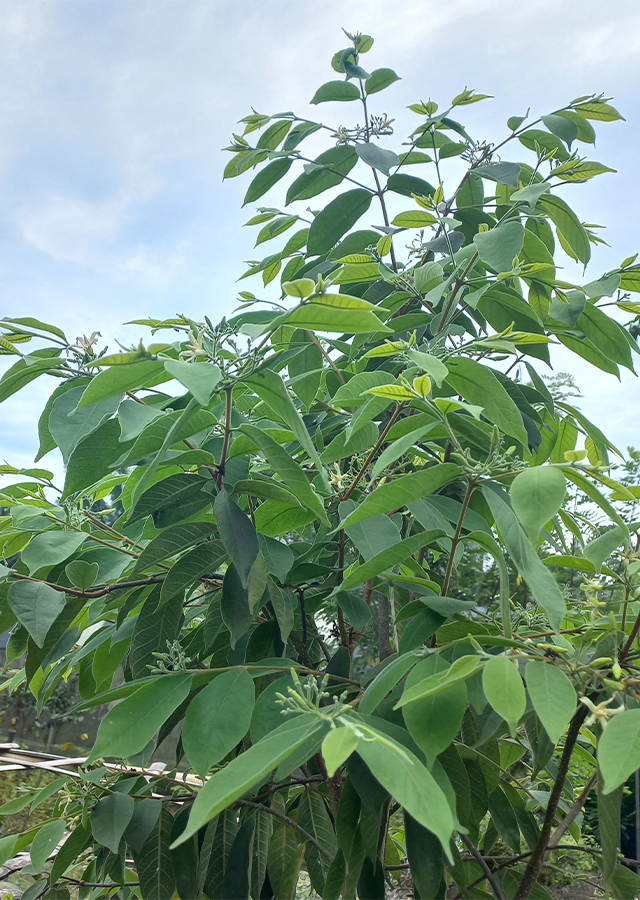
- Leaves green, elliptic to ovate or broadly oblong shaped, apex acuminate, base acute, tomentose (finely wool-like hairy) on both sides, arrangement opposite, petiolate, veins pinnate with 10-15 pairs of secondary veins. The petiole bears few to many pectinate glands in its axil.
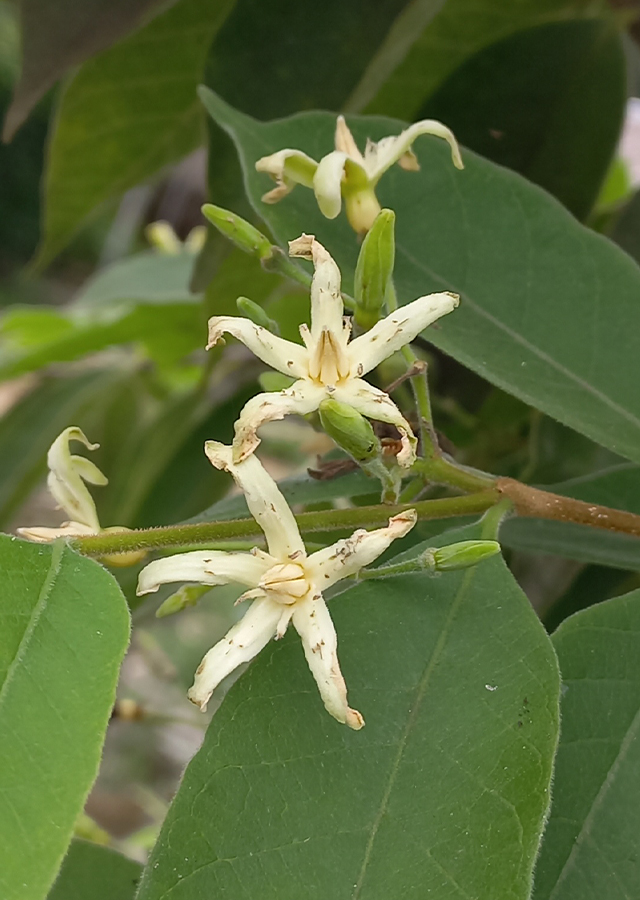
- Flowers actinomorphic (radial symmetry), bisexual, usually fragrant, with 5 pale yellowish, pink or reddish petals, corolla with a cylindrical to campanulate tube, tube length 3-7 mm, lobe length 8-16 mm. Calyx very deeply divided, lobes imbricate. Stamens located within the mouth of the corolla tube. Inflorescence terminal or axillary.
- Fruit consisting of a pair of pendulous follicles, complete or fused only at the very base, terete or compressed, splitting entirely along the adaxial suture.
- Seeds numerous per follicle, narrowly fusiform, with a basal tuft of hairs, embryo upright, cotyledons broad and convoluted.
Cultivation
Propagation is done generatively using seed.
Chemical Content
Conessine dihydrate, holarrhine, kurchicine, alkaloids, flavonoids, phlobatannins, phenolics, tannins, β-sitosterol, lupeol, α-amyrin, glycoflavones-iso-orientin, isoflavones, wrightiadione, phenolic acids, saponins, steroids, terpenoids.
Benefits
Helps treat menstrual complaints and kidney complaints, kidney stones, an antidote to snake bites and scorpion stings, relieves fever, dysentery, toothache, diarrhea, headaches, eye diseases such as cataracts, heals uterine wounds, can expel unclean blood, and speeds up postpartum recovery, acts as an expectorant. Has antipyretic, antibacterial, diaphoretic, analgesic, and anti-inflammatory activity.
Local Names
Benteli lalaki (Java), Bintaos (Sunda), Soliti (Sulawesi).
Traditional Recipes
The following recipes reflect traditional knowledge passed down through generations, not a substitute for professional medical diagnosis or advice. Consult a healthcare provider before use.
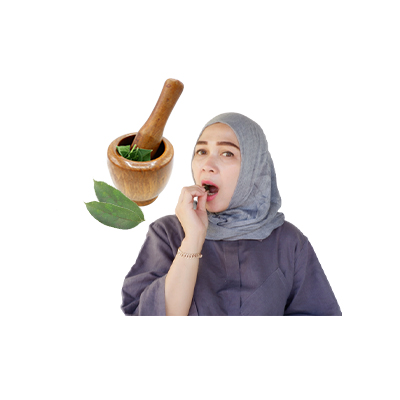
1. Toothache
- Take an adequate amount of fresh mentaos leaves and wash until clean.
- Grind until it becomes a paste.
- Apply the leaf paste as a poultice on the aching tooth.
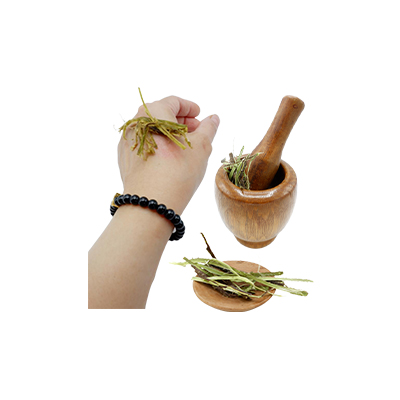
2. Antidote to snake bites and scorpion stings
- Take an adequate amount of mentaos bark and root and wash until clean.
- Pound until softened.
- Apply as a poultice on the area bitten or stung by a snake or scorpion.
Reference Sources
- Royal Botanic Gardens. Plants of the World Online: Wrightia arborea (Dennst.) Mabb. https://powo.science.kew.org/taxon/urn:lsid:ipni.org:names:82831-1. 24-02-2022.
- Useful Tropical Plants Database. 2021. Wrightia arborea. http://tropical.theferns.info/viewtropical.php?id=Wrightia+arborea&redir=Wrightia+tomentosa. 24-02-2022.
- Khyade Mahendra S., Vaikos Nityanand P. 2014. PHARMACOGNOSTIC EVALUATION OF WRIGHTIA ARBOREA (DENSST.) MABB. Int. J. Res. Ayurveda Pharm. 5(1).
- Lakshmipriya T. et al. 2017. ANTIOXIDANT, ANTIMICROBIAL AND ANTIPROLIFERATIVE ACTIVITIES OF LEAF EXTRACTS OF THE INDIAN TRADITIONAL MEDICINAL PLANT WRIGHTIA ARBOREA. IJPSR, 8(3): 1124-1133.
- Ningsi E. W. et al. 2018. PEMANFATAN TUMBUHAN SOLITI (WRIGHTIA ABOREA) SEBAGAI PENGOBATAN HERBAL TRADISIONAL PADA MASYARAKAT SUKU MUNA. Jurnal Penelitian Budaya, 3(2): 32-40.
- PROTA. Wrightia arborea. https://prota4u.org/prosea/view.aspx?id=30. 24-02-2022.