Zanthoxylum acanthopodium DC.
Summary
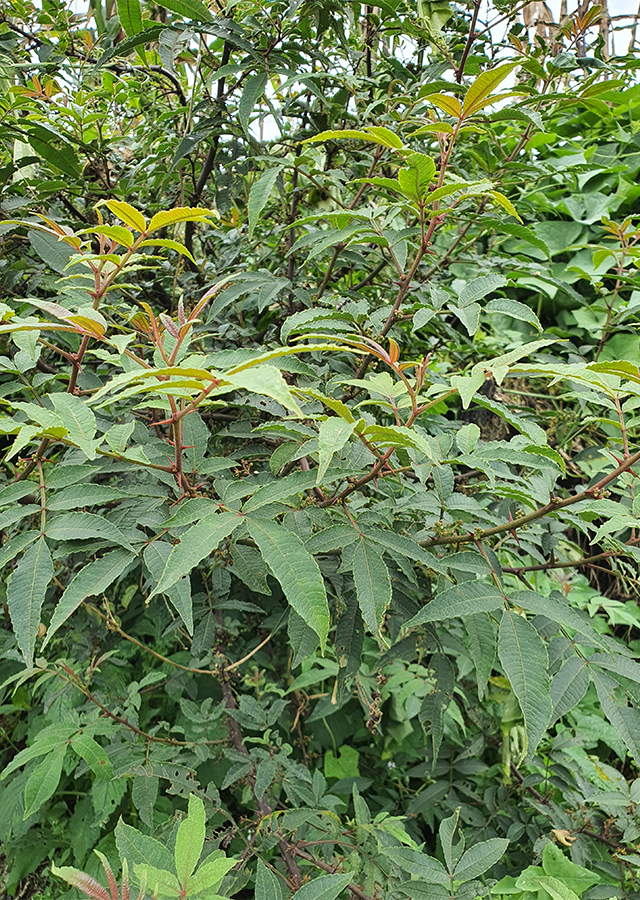
Andaliman (Zanthoxylum acanthopodium) is a shrub or small tree up to 5 meters tall from the Rutaceae family distributed from South Asia to North Sumatra, especially Toba Samosir and Tapanuli. This spice, characteristic of the Batak people, gives a unique tingling sensation to dishes and has potential as a natural food preservative. Andaliman is traditionally believed to treat dyspepsia and gum and dental problems.
Agroecology
Andaliman's natural habitat grows in open land or highland secondary forest and shrublands, at elevations of 1,400-3,200 m asl, with low to moderate soil acidity (pH 3-5). In Indonesia, andaliman grows wild in mountains at an elevation of 1,400 m asl at temperatures of 15-18°C, while in China the andaliman plant grows at an elevation of 2,900 m asl. It can also be found growing in rocky areas and hanging from cliffs in the Himalayas. Prefers sandy loam soil, post-burn soil, or clay to red laterite soil. Andaliman can adapt and grow on land with high sunlight intensity, as well as partial shade.
Morphology
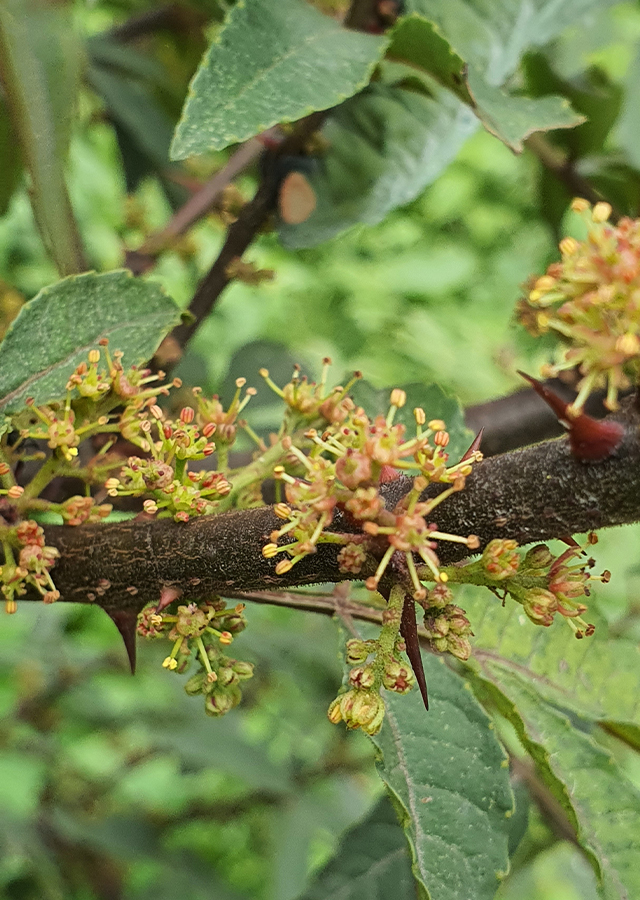
- Stem, branches, and twigs spiny.
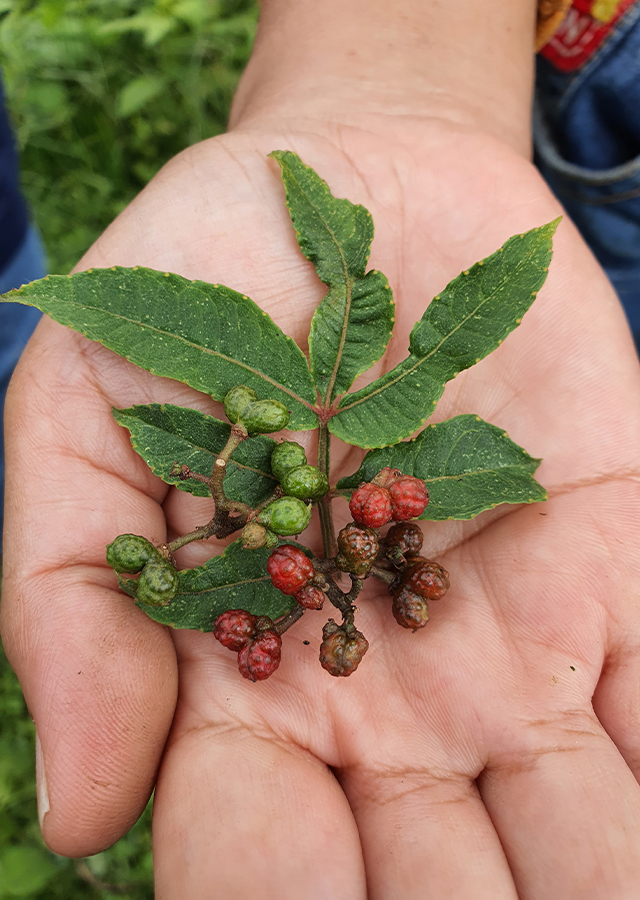
- Leaves scattered, petiolate, odd-pinnately compound, 5-20 cm long and 3-15 cm wide, with oil glands (leaves have a distinctive, pungent aroma when squeezed). Leaflets number 3-11, spiny, oblong to oblong shaped, apex tapering, margins finely serrate, the terminal one largest. Upper leaf surface glossy green and lower surface light green or pale, while young leaves have a green upper surface and reddish green lower surface.
- Flowers small, flower base flat or cone-shaped, calyx 5-7 free and pale yellow, often with red or purple spots at the calyx base. Stamens 5-6 seated on the flower base, anthers reddish, pistils 3-4, ovary apocarpous, ovary superior. Arising in the leaf axil, limited compound inflorescence, umbellets forked compound, bisexual.
- Fruit a true capsule, aromatic, round, 2-3 mm in diameter, young fruit green, while ripe fruit is red. Fruit clusters consist of 10-20 fruits attached to the stalk.
- Seeds one per fruit, hard shell, glossy black.
Cultivation
- Andaliman propagation is generally done through generative propagation using seed because andaliman produces a fairly large number of seeds. However, andaliman seed germination rate is very low.
- Andaliman seed germination is done by scattering the seeds in a nursery bed, i.e. a shaded area measuring 1 x 1 m. After the seeds are scattered, they are then thinly covered with soil, and dried grass or alang-alang grass is spread over the nursery bed. This is then burned so that the hard seed coat (horn coat) breaks open faster. This nursery bed is left for up to 1 month, then the germinated seeds are moved to polybags containing planting medium for 2 months. After that, the seedlings can be transplanted to the prepared planting field.
- Andaliman propagation is also done vegetatively (stem cuttings and shoot cuttings).
Chemical Content
Phenolics, saponins, tannins, alkamides, flavonoids, terpene alkaloids, amides, benzophenanthridine alkaloids, pyranoquinoline alkaloid, quaternary isoquinoline alkaloid, aporphine alkaloids, several types of lignans, geranyl acetate, limonene and citronellol, β-myrcene, β-ocimene, linalool, E-1-decenal, α-pinene, and geraniol.
Benefits
A stomach ache remedy, treats dyspepsia, fever, cholera, cough, treats gum and dental problems, a lotion for scabies and mange, an appetite stimulant, wards off digestive diseases, relieves pain, rheumatism, boosts blood, strengthens bones, warms the body and treats colds, a vermifuge. Has antimicrobial, antioxidant, and anticancer activity.
Simplisia
- Prepare fresh andaliman seeds, wash clean with running water then drain.
- Sun-dry directly for several days or use an oven at 60°C for up to 2 hours.
- Grind using a blender until it becomes powder.
- Store the simplicia in a clean, airtight plastic or container.
Local Names
Tuba (Batak Simalungun), Itir-itir (Batak Karo), Sinyar-nyar (Batak Angkola).
Traditional Recipes
The following recipes reflect traditional knowledge passed down through generations, not a substitute for professional medical diagnosis or advice. Consult a healthcare provider before use.
1. Fever
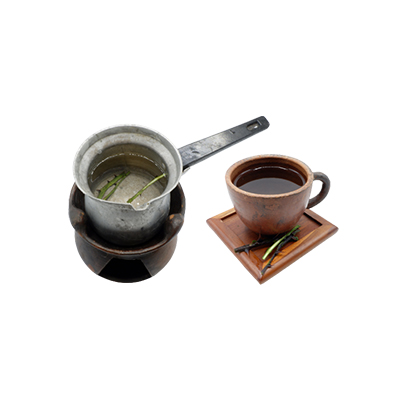
- Prepare andaliman bark and wash until clean.
- Boil the bark until it boils.
- Let it stay warm.
- Strain then drink.
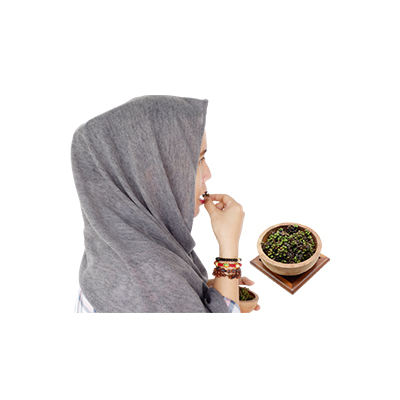
2. Treats colds
- Prepare andaliman fruit and wash until clean.
- Chew directly to warm the body and treat colds.
Reference Sources
- Royal Botanic Gardens. Plants of the World Online: Zanthoxylum acanthopodium DC. https://powo.science.kew.org/taxon/urn:lsid:ipni.org:names:775546-1. 01-03-2022.
- Asbur Y., Khairunnisyah. 2018. Pemanfaatan andaliman (Zanthoxylum acanthopodium DC) sebagai tanaman penghasil minyak atsiri. Jurnal Kultivasi Vol. 17(1): 537-543.
- Useful Tropical Plants Database. 2021. Zanthoxylum acanthopodium. https://tropical.theferns.info/viewtropical.php?id=Zanthoxylum+acanthopodium. 03-01-2022.
- PUSTAKA Kementerian Pertanian Republik Indonesia. 2021. Andaliman Rempah Batak Kaya Manfaat. http://pustaka.setjen.pertanian.go.id/index-berita/andaliman-rempah-batak-kaya-manfat. 01-03-2022.
- Kholibrina CR, Aswandi A. 2021. The ethnobotany and ethnomedicineof Zanthoxylum acanthopodiumin Lake Toba, North Sumatra, Indonesia. Jurnal Lahan Suboptimal: Journal of Suboptimal Lands. 10(1):78-90.DOI: 10.36706/JLSO.10.1.2021.526.
- Nurlaeni Y., Junaedi D. I. 2018. STUDI EKOLOGI HABITAT, TEKNIK PERBANYAKAN DAN PENGOLEKSIAN DALAM RANGKA KONSERVASI EX-SITU ANDALIMAN (Zanthoxyllum acanthopodium DC.). BIOMA 14(2): 79-88.