Zapoteca portoricensis (Jacq.) H.M.Hern.
Summary
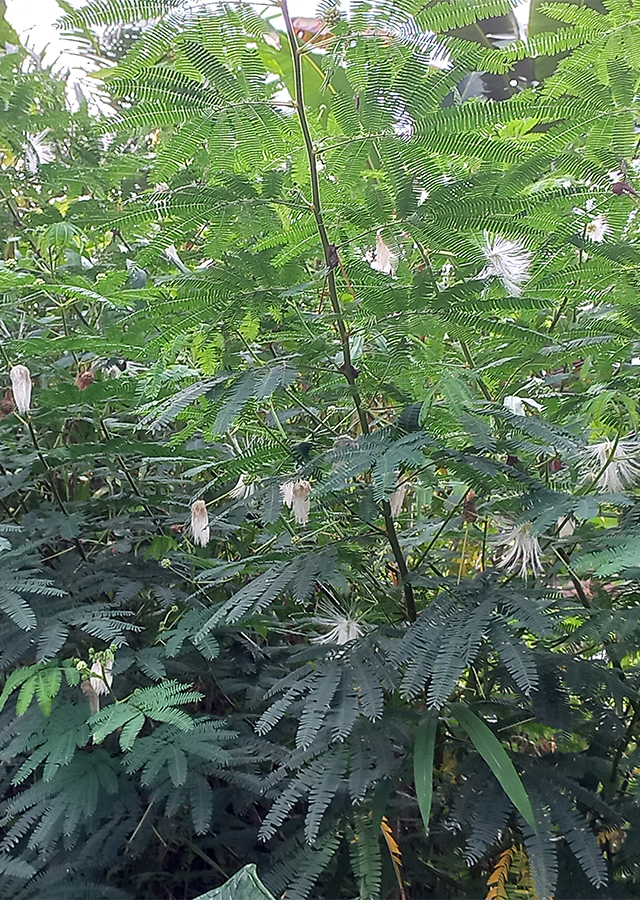
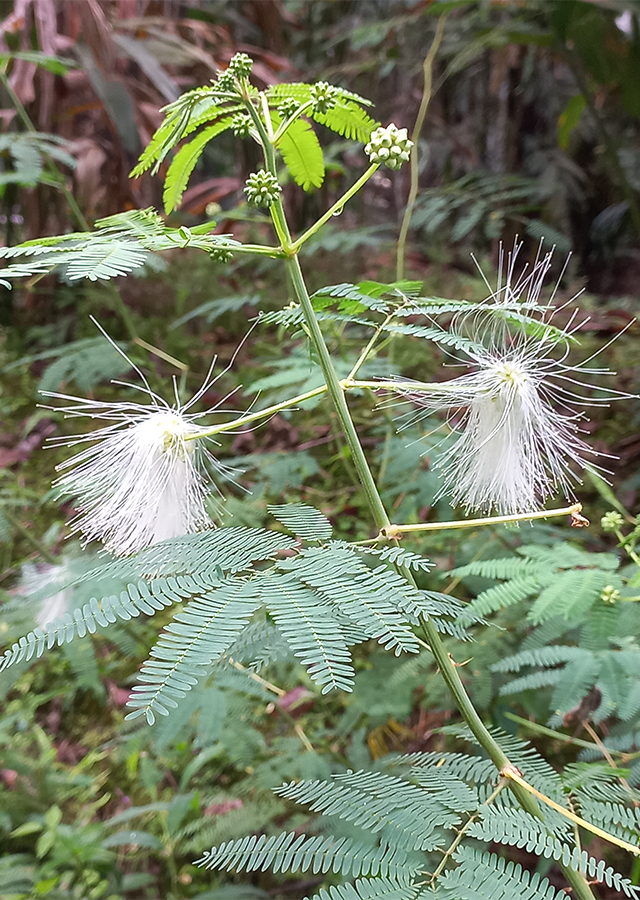
Kaliandra putih (Zapoteca portoricensis) is a shrub 3-8 meters tall from the Fabaceae family native to Mexico, Panama, and the West Indies. Its leaves are used as animal feed, while its flowers are a source of bee nectar. Kaliandra putih is traditionally believed to have antibacterial and antifungal activity.
Agroecology
Kaliandra putih grows in various soil types from deep volcanic soil, to alluvial, to eroded sandy loam soil. This plant grows in areas with a mean minimum annual temperature of 18-22°C and is not frost-tolerant. Kaliandra lives in various soil types and appears to be tolerant of somewhat acidic soil with a pH around 4.5, but is not tolerant of poorly drained soil that is regularly waterlogged.
Morphology
- Stem woody, upright or ascending, branches arching, spreading or bent, sturdy, old twigs hairless or slightly hairy, young twigs sparsely to densely hairy.
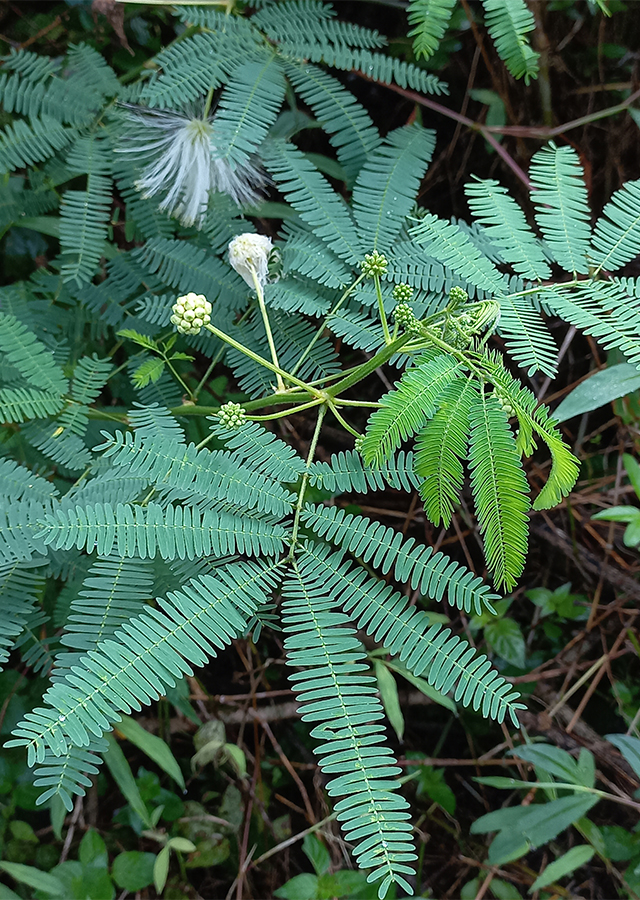
- Leaves compound, pinnae 2-6 pairs, leaflets 10-30 pairs, linear or linear-oblong, straight or slightly curved, 8-16 mm long, 2.5 mm or less wide, faintly veined, blunt, thin.
- Flowers on slender stalks, clustered or solitary, 3-10 cm long, calyx 2 mm long, corolla 3-4 mm long, stamens white, 1.5-2 cm long.
- Fruit a pod 4-10 cm long, 6-9 mm wide, hairless when mature, blunt, narrowing toward the base, containing 3-10 seeds.
- Seeds with an elliptic line or depression (pleurogram), ovoid to rounded, seed surface smooth, brown, or black.
Cultivation
Propagation is generative using seed. Seeds are dispersed in nature with the help of animals or humans when collecting leaves as animal feed. For cultivation, seeds can be planted directly in the field or sown first in a nursery. Seeding or sowing should preferably be done at the start of the rainy season.
Chemical Content
Alkaloids, flavonoids, saponins, tannins, cardiac glycosides, and anthraquinones.
Benefits
Has potential and activity as an antibacterial and antifungal.
Local Names
Information not found. Further research is needed.
Reference Sources
- Royal Botanic Gardens. 2021. Zapoteca portoricensis (Jacq.) H.M.Hern.. https://powo.science.kew.org/taxon/urn:lsid:ipni.org:names:943976-1. 20-03-2022.
- K.N. Agbafor, E.I. Akubugwo, M.E.Ogbashi, P.M. Ajah and C.C. Ukwandu. 2011. Chemical and Antimicrobial Properties of Leaf Extracts of Zapoteca portoricensis. Research Journal of Medicinal Plants, ISSN 1819-3455/ DOI: 10.3923/rjmp.2011
- National Museum of Natural History. White Shuttlecock Zapoteca portoricensis (Jacq.) H. M. Hern.. https://eol.org/pages/642480.
- I.T. Gbadamosi and A. Egunyomi. 2014. Ethnobotanical Survey of Plants Used for the Treatment and Management of Sexually Transmitted Infections in Ibadan, Nigeria. Ethnobotany Research & Applications 12:659-669 (2014).