Ziziphus spina-christi (L.) Desf.
Summary
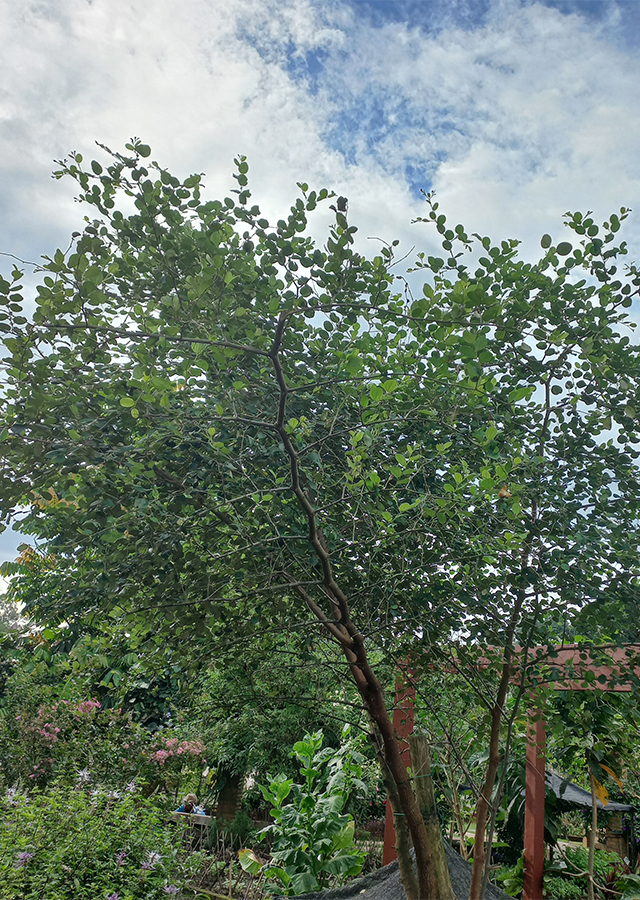
Bidara arab (Ziziphus spina-christi) is a shrub up to 15 meters tall from the Rhamnaceae family spread from North Africa to the Middle East and South Asia. Its sweet fruit is processed into flour or paste, while its flowers are an important nectar source for high-quality honey production in the Middle East. Bidara arab has long been used in traditional Iranian and African medicine for headaches, fever, and snake bites.
Agroecology
Bidara arab is a drought and high-temperature resistant plant, usually found in dry areas, deserts, semi-deserts, valleys and savannas, with an average annual rainfall from 50 mm to 500 mm and an average annual temperature in the range of 19-28 °C. This plant prefers alluvial plains with deep soil, but is also able to grow in clay soil (where water is available) as well as in reasonably saline soil, usually at elevations between sea level and 2000 m asl. Based on ecological studies, it is reported that its largest stands are seen on alluvial plains with loamy, sandy loam and silty soil, and slightly alkaline (pH 7-8.2) and prefers a sunny position. This species can also tolerate a dry season of 8-10 months and can withstand waterlogging for up to 2 months.
Morphology
- Roots have a very deep taproot and spreading lateral roots.
- Stem paired thorns (one straight and the other curved) or sometimes thorns absent, bark gray to brown, cracked, scaly, branches whitish to straw-colored.
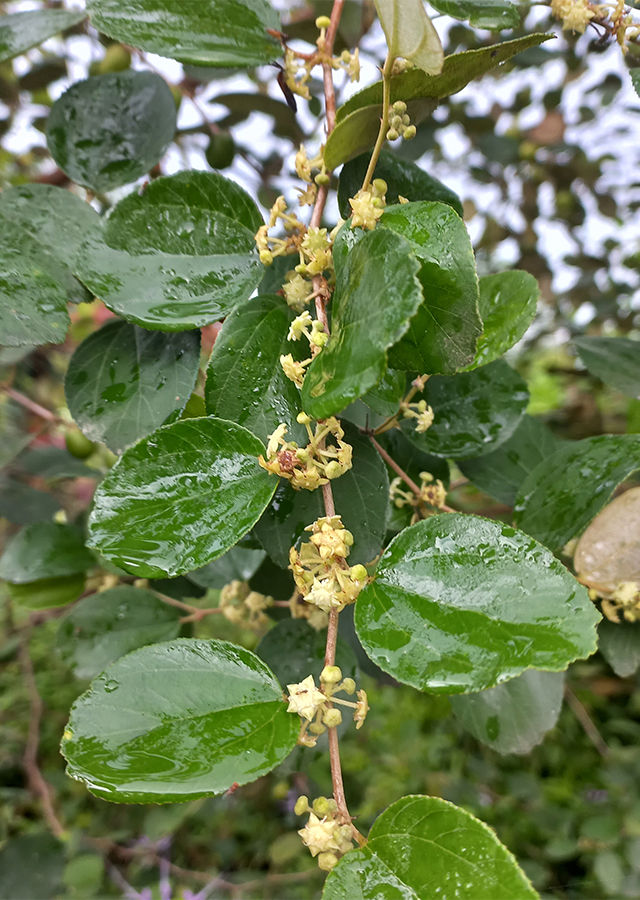
- Leaves simple, alternate, ovate-lanceolate or elliptical shape, finely serrated or crenulate margin, leaf tip pointed to rounded, rough at the base, round to nearly heart-shaped at the base, smooth leaf margin, hairless on the upper surface, finely pubescent below, lateral veins prominent.
- Flowers small, yellow-green and hermaphroditic, sweetly scented. Corolla and calyx 5-lobed. Stamens numbering five. Inflorescence a cyme, densely clustered in the leaf axil.
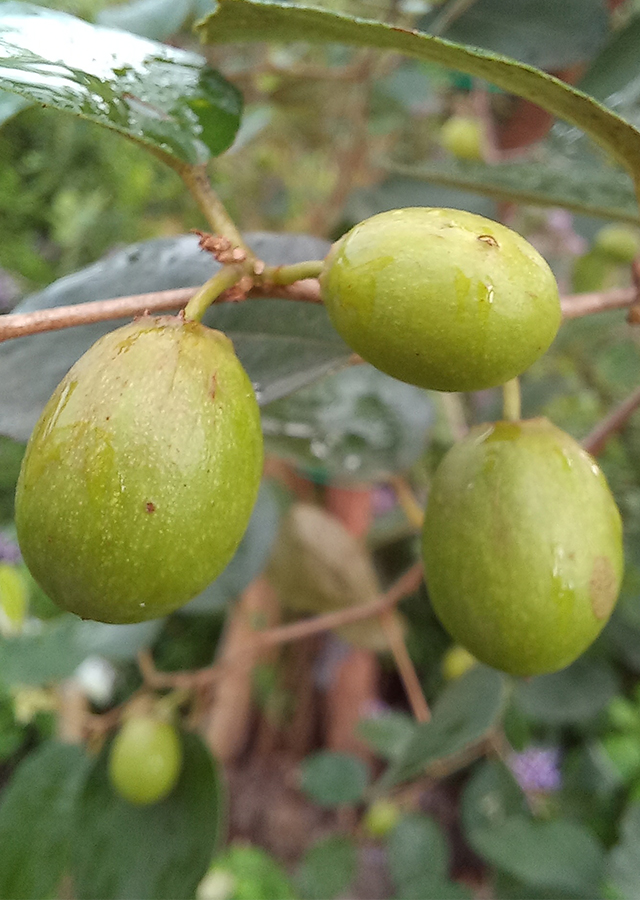
- Fruit round, seeded, reddish-yellow.
- Seeds hard, inseparable and surrounded by fruit flesh.
Cultivation
Plant propagation can be done generatively (seeds).
Chemical Content
Flavonoid, saponin, polyphenol, riboflavin, tannin, sterol, triterpenoid, glycoside, essential oil (geranyl acetone, methyl hexadecanoate, methyl octadecanoate, farnesyl acetone, hexadecanol, and ethyl octadecanoate), alkaloid (ziziphine, jubanine, amphibine, alpha terpineol, and linalool).
Benefits
Treats headaches, stomach ache, measles, chest pain and respiratory problems, addresses snake bites, reduces abscesses and boils, various surface wounds, reduces eye inflammation, relieves fever and toothache, rheumatism, nourishes hair, a sedative, laxative, abortifacient, has anthelmintic and antidiarrheal properties, antioxidant, emollient (preventing skin dryness) and astringent, antihyperglycemic, antibacterial, antioxidant, and antifungal properties.
Simplisia
- Prepare fresh bidara arab leaves, wash clean with running water then drain.
- Dry under sunlight or with an oven at 40 °C until moisture content reaches 10%.
- Store in a clean, airtight container.
Local Names
Widara, Dara, Bukol (Java), Bekul (Bali), Sawu, Rote, Kom (NTT).
Traditional Recipes
The following recipes reflect traditional knowledge passed down through generations, not a substitute for professional medical diagnosis or advice. Consult a healthcare provider before use.
1. Wounds
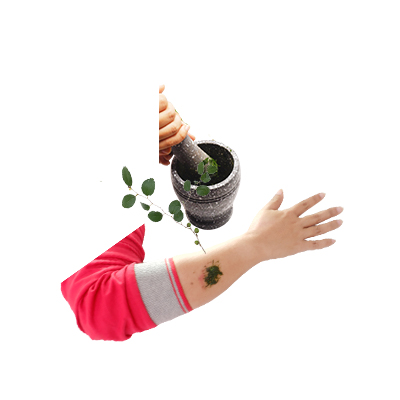
- Take fresh bidara arab leaves as needed and wash until clean.
- Boil the leaves until soft then mash into a paste.
- Apply the paste to the wounded skin.
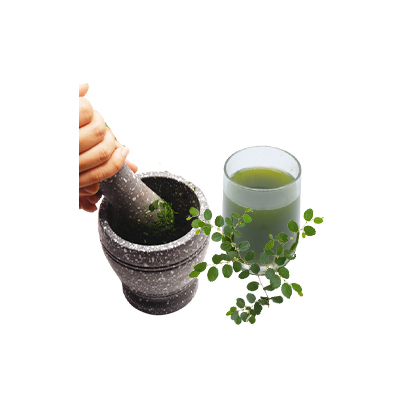
2. Diarrhea
- Prepare fresh bidara arab leaves as needed and wash until clean.
- Mash into a paste.
- Squeeze the leaf paste and take the extract.
- Drink the leaf extract to relieve diarrhea.
Reference Sources
- Royal Botanic Gardens. 2021. Plants of the World Online: Ziziphus spina-christi (L.) Desf. http://www.plantsoftheworldonline.org/taxon/urn:lsid:ipni.org:names:719427-1. 30-10-2021.
- Useful Tropical Plants Database. 2021. Ziziphus spina-christi. http://tropical.theferns.info/viewtropical.php?id=Ziziphus+spina-christi. 30-10-2021.
- CAB International. 2021. Invasive Species Compendium: Ziziphus spina-christi (Christ's thorn jujube). https://www.cabi.org/isc/datasheet/57569#todescription. 30-10-2021.
- Hakim A.R., Syafnir L., Maulana I.T. 2020. Potensi Daun Bidara Arab (Ziziphus Spina-Christi L.) Sebagai Penyubur Rambut. Prosiding Farmasi 6(2). http://dx.doi.org/10.29313/.v6i2.23997.
- Asgarpanah J., Haghighat E. 2012. Review: Phytochemistry and pharmacologic properties of Ziziphus spina christi (L.) Willd. African Journal of Pharmacy and Pharmacology Vol. 6(31): 2332-2339. DOI: 10.5897/AJPP12.509.
- Saied S.A., Gebauer J., Hammer K. 2008. Ziziphus spina-christi (L.) Willd.: a multipurpose fruit tree. Genet Resour Crop Evol, 55:929–937. DOI 10.1007/s10722-007-9299-1.